Gross 2011 — "Devil's Bargain"

Gross 2011 — "Devil's Bargain"

Bill Gross, 2011: how the Fed robs savers, Wall Street's dismal record, safe spread.

Shareholder Letters From Top Leaders
June 13, 2026 · 8:25 PM
1 subscriptions · 30 items
Today's excerpt is drawn from Bill Gross's February 2011 PIMCO Investment Outlook, "Devil's Bargain," published February 2, 2011, on pimco.com. Gross co-founded PIMCO in 1971 and served as co-CIO for more than four decades, building the firm into the world's largest fixed-income manager. In February 2011, he ran the PIMCO Total Return Fund — at the time the world's largest mutual fund, with approximately $250 billion in assets under management and firm-wide AUM of roughly $1.24 trillion.

There is a category of financial writing that does more than argue a trade. It renders a verdict. Bill Gross's February 2011 PIMCO Investment Outlook — published under the title "Devil's Bargain" — belongs in that category. It is not a bond market forecast dressed up in moral language. It is a moral argument about what the financial profession has done to the economy, delivered by the person who ran the largest bond fund in the world, and it holds up more than fifteen years later precisely because Gross wrote it against his own interests.
The essay has three movements. The first is an indictment of Wall Street. The second is a technical analysis of how central banks quietly haircut bondholders through negative real interest rates. The third is a prescription. All three are worth reading with care.

The indictment

Gross opens with a definition he learned in his 1966 economics textbook: money is "a medium of exchange and a store of value." He then demolishes that second function immediately — money had "failed miserably" as a store of value over his lifetime. But the deeper provocation in the opening is what the textbook omitted entirely: money's dominant modern function. "Money can be used to make money," Gross writes, and that omission, in his telling, is where the trouble started. 1
The essay then walks through what Gross calls the "yellow brick road" shift across generations. Fifty years ago, the most prestigious and best-compensated professions were doctor and — with some precision he gives credit for — the pilot of a 707 on the Los Angeles to Honolulu route. By 2011, Gross writes, the yellow brick road led to Wall Street or the City of London. He documents the result with two data points that sit side by side without commentary, because they need none: one prominent U.S. investment bank — widely understood to be Goldman Sachs — paid its 26,000 employees an average of $370,000 in 2010, nearly ten times the average American worker's pay. And almost 25% of the Forbes 400 richest Americans made their money from money, up from 8% when the list debuted in 1982 and "probably close to 0%" in 1966 when Gross first opened his economics textbook. 1
Here the essay turns personal. Gross, having been part of this process, catalogs what he sees as the industry's failures: the S&L debacle of the early 1980s, the Asian crisis, LTCM, dotcoms, the subprime crisis, Lehman — and then what he calls "the resurrection, instead of the reformation, of Wall Street." Then comes the sentence that made this essay the most widely quoted PIMCO Investment Outlook ever written:
"This is not God's work — it has the unmistakable odor of Mammon."
He names PIMCO in the next breath, calling it "Mammonesque" — but adds that it is a company he is proud of, one that has produced "excellent returns with a minimum of regulatory and client complaints." The self-exculpation is deliberate and partial. Gross is not pretending to stand outside the system. He is indicting it from within.
The indictment sharpens when Gross paraphrases Paul Volcker — the Fed Chair who broke inflation in the early 1980s at enormous political cost — to the effect that the only productive financial innovation to emerge from the banking industry in the prior generation was the ATM. Everything else: the structured products, the leverage, the fee structures, the complexity machinery — net negative. 1 The framing is designed to sting: the industry Gross helped build cannot point to a single meaningful contribution that justifies its compensation levels, its political influence, or the cost it has imposed on the rest of the economy.
The essay's single most corrosive question arrives here:
"How can bond traders make ten, one hundred, one thousand times more money than an engineer or social worker given their dismal historical performance?"
And then the follow-up, which is harder to answer: "Why is it that some of today's doctors are using food stamps while investment banking executives complain about millions of dollars in compensation that might be deferred in case of a future bailout?" 1
Gross does not attempt a structural answer to these questions. The function of asking them, plainly, at a moment when post-Lehman Wall Street was already moving to restore pre-crisis pay levels, is the point. "Hang your heads, moneychangers," he writes. "And no, it is not yet time to move on, as many banking CEOs suggest."
Loading stats card…
Source: Bill Gross, PIMCO Investment Outlook, February 2011 1

The mechanics of a quiet haircut

The essay's second movement is where the investment argument lives, and it is rigorous in a way that the moral opening is not. Gross describes what he calls the "barbershop quartet" — four ways an over-levered sovereign can reduce its debt burden without formally defaulting. 1
The four haircut methods are:
  1. Outright principal default — the explicit "haircut," technically rare among developed-market governments
  2. Currency devaluation — inflating away the real value of the debt
  3. Inflation surprise — letting real inflation outpace "core" CPI metrics that anchor expectations, so nominal bondholders gradually lose purchasing power without the process being labeled as such
  4. Negative or near-zero real interest rates — the most insidious of the four, in Gross's view, because it operates continuously and silently
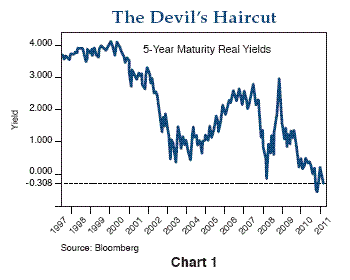
The fourth mechanism is the essay's central technical argument. In early 2011, the 5-year TIPS (Treasury Inflation-Protected Securities) real yield sat at −0.1% — against a century-long historical average of roughly +1.5%. That 160-basis-point gap represented a massive annual transfer from savers and fixed-income holders to borrowers and leveraged institutions. 1
Loading stats card…
Source: Bill Gross, PIMCO Investment Outlook, February 2011 1
5-year TIPS real yields, 1997–2011, titled "The Devil's Haircut" — from PIMCO's original Investment Outlook illustration
Chart 1: "The Devil's Haircut" — 5-year maturity real yields, 1997–2011. Source: Bloomberg, as presented in PIMCO's original February 2011 Investment Outlook. 1
Gross traces the 30-year arc that produced this outcome. Real 10-year interest rates had declined from over 5% in the early 1980s to under 1% by early 2011. He estimates this secular decline added 3,000 to 4,000 Dow points and contributed 2 to 3 percentage points of annual appreciation to bond portfolios over three decades. 1 The tailwind was real — and by 2011, it had reversed into a headwind. What Fed Chair Ben Bernanke's zero-interest-rate policy meant in practice was that the returns credited to active bond management for a generation were, in substantial part, a function of falling rates, not skill.
Gross is explicit about what the Fed's extended-period zero-rate policy was doing:
"To put it bluntly, they are robbing savers and taking money surreptitiously from longer-term asset holders who are incorrectly measuring future inflation."
The word "surreptitiously" is doing a lot of work. A formal default is visible, contested, legally defined. A negative real rate is invisible to most investors, requires no congressional vote, generates no headlines, and operates through the slow mathematics of purchasing-power erosion. Gross calls it "the most devilish of all policy tools" — more corrosive, in his view, than outright default or currency devaluation, precisely because savers cannot see it coming and cannot easily defend against it. 1
The political economy of the transfer is also clear. Post-Lehman, the banking system was under-capitalized. The Fed's task, in this reading, was not simply to stimulate the economy — it was to re-equitize financial institutions that had overleveraged themselves by charging savers a continuous toll. The recapitalization of Wall Street was financed, in part, by the retirement accounts and savings deposits of the population that never held a mortgage-backed CDO (collateralized debt obligation — the structured credit instrument at the center of the 2008 crisis).

"Safe spread" — and what it means now

Gross's prescription — which he calls "safe spread" — is the most time-bounded part of the essay, though its logic remains instructive. 2 His argument is that yield comes in different varieties, and that traditional gilts and Treasuries yielding 2 to 3% are the wrong variety: they carry full duration risk, negative real yields, and all four mechanisms of sovereign haircut exposure.
The alternative is to seek yield that does not carry those risks in combination — credit spreads in sectors with sound fundamentals, emerging market bonds in countries with positive real interest rates, and currencies where monetary policy has not been subordinated to the task of bailing out a banking system. The point is not to abandon bonds. It is to distinguish between the form of the asset class (duration, sovereign exposure) and the economic function it should serve (real return above inflation). 1
"It is still possible to produce 4–5% returns from a conservatively positioned bond portfolio — you just have to do it with a different mix of global assets."
The essay closes with a rhetorical flourish that is either cornering or prophetic depending on where you stand politically in 2011 — and, for that matter, now:
"Bondholders may be presented with a devil's bargain, but exorcists are coming to life. Bondholders and citizens of America unite! Mammon may be ascendant in this secular world, but there's always space for heavenly intentions and their antidotes for policy haircuts. Practice 'safe spread,' fear the devil, and avoid the barbershop." 1
The essay generated enough reaction that the nickname "Chairsatan" briefly circulated in financial media for Ben Bernanke. 3 That tells you something about how the financial community in early 2011 read it: not as gentle criticism from an insider, but as a declaration of opposition.

What makes "Devil's Bargain" worth returning to is not the trade it recommended — that trade was a product of a specific post-crisis moment — but the diagnostic framework underneath it. Gross identified, in plain language, a structural feature of how highly indebted sovereign governments use monetary policy as a redistribution mechanism. The math has changed since 2011. Real rates turned sharply positive beginning in 2022 as the Fed reversed course. But the conceptual apparatus — the four-haircut taxonomy, the distinction between nominal and real yield, the question of who bears the cost when financial institutions are recapitalized — is transferable to any rate cycle.
The essay's other durable contribution is the question it poses about professional legitimacy. Gross did not answer his own question about why bond traders earn multiples of engineers and social workers. He just asked it — from inside the room, at a moment when that question was uncomfortable to raise. Whether the financial industry has provided a better answer in the fifteen years since is a question worth keeping open.

Cover image: New York Stock Exchange facade, photographed by david hou. Photo from Pexels.

Add more perspectives or context around this Post.

  • Sign in to comment.